
15 High-Impact Company Team Building Activities That Actually Build Trust
From Resort Games to Real Trust: Rethinking Team Building
Another hotel conference hall. Another awkward icebreaker. By Monday, the same people dominate meetings while unresolved handoffs return to Slack.
Useful company team building activities put those habits under observation. On an outdoor course, limited materials and shared deadlines expose friction quickly. Physical risk stays controlled; decisions carry consequences within the simulation.
At Value Lanes, we bring teams outside to work through challenges together, then examine what happened. With 22+ years of experience, Value Lanes has worked with 300+ organisations and more than 2.5 lakh participants, using structured experiential challenges to make team behaviour observable, discussable and easier to improve. The conversation afterward connects the exercise to how colleagues work.
Why Passive Icebreakers Fail to Drive Real Engagement
Polite participation can disguise uneven contributions. Without shared obstacles, dominant voices rarely have to reconsider their approach. Pressure alone, however, does not create psychological safety; people need permission to question decisions without humiliation.
Gallup’s 2026 report puts Indian employee engagement at 23%, using the three-year rolling average ending in 2025. Participation alone is a poor substitute for genuine involvement. Without reflection afterward, even energetic games become isolated memories.
For an L&D team, the more useful question is not whether employees enjoyed the activity, but what the activity revealed about communication, decision-making, trust and accountability.
15 Experiential Team Activities Mapped to Workplace Outcomes
The most useful offsite team building activities start with the behaviour or workplace challenge you want to address, rather than with a predetermined game. A leadership team working on delegation needs a different simulation from a newly formed cross-functional team trying to improve handoffs.
Programme design should consider the team objective, participant profile, physical comfort levels and the behaviours to be observed. Value Lanes facilitators can then select and adapt suitable activities around those requirements.
Category 1: Strategic Planning & Resource Allocation
- The Acid River Bridge Build: Cross a marked gap using limited planks and crates before time expires.
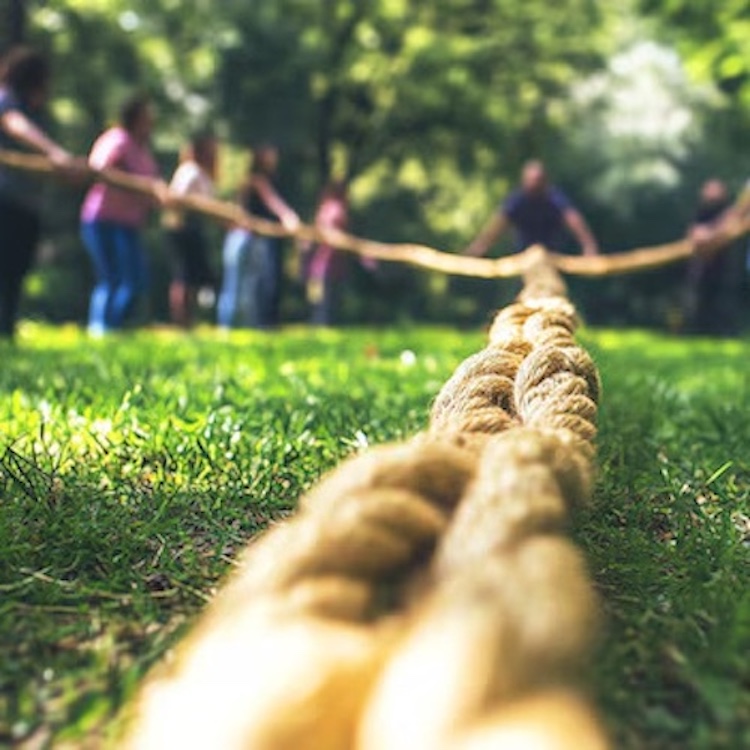
- The Blind Square (Rope Formation): Blindfolded participants shape a continuous 50-foot rope into a square through spoken instructions.
- Minefield Navigation: Guide a blindfolded partner through marked obstacles, testing instruction clarity and listening.
- Tactical Cargo Transport: Move awkward, fragile mock cargo across terrain using basic levers and coordinated effort.
- Tower of Babel (Silent Construction): Assemble a stable structure against the clock without speaking.
Category 2: Crisis Management, Agility & Lateral Thinking
- The Low-Rope Nitro Crossing: Negotiate a simulated gap using a supervised pendulum swing; completion includes everyone.
- Bamboo Stretcher Extraction: Build a field stretcher and transport a training dummy along an approved route.
- The Spider’s Web: Plan passage through a rope matrix without touching its boundaries, using supervised assistance.
- Shelter Under Siege: Build a shelter with limited canvas and binding lines while the clock runs.
- The Pressure Cooker Comm Link: Send fragmented information to remote coordinators who must assemble a workable response.
Category 3: Cross-Functional Alignment & Shared Accountability
- Platform Trust Catch (Controlled Platform Drill): An optional, professionally assessed platform exercise with trained spotting and explicit consent.
- Chain-Link Relay: Move as an interconnected group, adjusting pace so nobody gets pulled behind.
- Blindfolded Radio March: Remote navigators interpret coordinates and guide participants along a controlled, supervised route.
- Catapult Engineering Challenge: Trade resources, construct launchers, and calibrate soft projectiles toward designated targets.
- The Final Obstacle Run: Complete an adapted circuit together; the fastest individual cannot secure the team’s result.
The table below shows how the same outdoor challenge can be interpreted through a workplace lens rather than treated as a standalone game.
Activity Matrix: Connecting Team Challenges to Workplace Friction Points
Start with the workplace problem, then select the exercise.
Activity Name | Core Focus Area | Workplace Parallel | Best For |
Acid River Bridge | Resource planning | Scope and budget limits | Engineering and product |
Low-Rope Nitro | Shared reliance | Launch dependencies | Cross-functional squads |
Silent Tower Build | Nonverbal alignment | Communication gaps | Remote/hybrid teams |
Blind Radio March | Command and execution | Remote delegation | Mid-to-senior leadership |
Obstacle Circuit | Collective endurance | Demanding sprints | Sales and growth |
Moving from “Fun Games” to Behavioural Change: The Role of the Debrief
The activity creates the experience. The debrief creates the learning.
The military’s After Action Review (AAR) asks:
- What did we intend to do?
- What actually happened?
- Why did the divergence occur?
- What will we do differently on Monday morning?
Facilitators can then connect what happened during the challenge to familiar workplace patterns such as unclear ownership, delayed escalation, over-reliance on one decision-maker or weak cross-functional communication.
Suppose the bridge exercise exposes dependence on one approver. The team could trial clearer handoff authority on Monday and track rework over subsequent weeks.
Experienced facilitators, including Value Lanes’ ex-army leadership team, help participants examine the decisions behind the outcome without turning the debrief into blame or judgement.
Safety and Facilitation: The Value Lanes Advantage
Value Lanes operates from its own secured 7.8-acre outdoor experiential-learning campus near Manchenbele Lake, giving the team greater control over programme flow, facilitation and activity setup than a standard resort venue.
Programmes are led under the direction of Major Vaibhav Kapoor and Col. Arun Dhar, bringing disciplined facilitation and structured observation into the learning process.
Safety considerations are built into programme planning, including participant profile, activity intensity, supervision requirements and emergency-response arrangements.
Value Lanes has worked with organisations including Accenture, TCS, Wipro, Microsoft, Siemens, Bosch, Deutsche Bank and Genpact.
Conclusion: Designing an Offsite That Transfers Learning Back to Work
A successful offsite should leave teams with more than a good memory. It should give them language for discussing how they communicate, decide, delegate and respond under pressure. Play without reflection leaves little behind; unsafe pressure discourages participation. Better challenges expose assumptions and give colleagues reasons to rely on each other. The programme therefore starts with the workplace outcome, not with a fixed list of games.
Planning a team offsite? Book a 20-minute scoping call with Value Lanes to discuss your team context, learning objectives and the right outbound training or leadership training in Bangalore around specific workplace outcomes.
Frequently Asked Questions
How do tactical team building activities compare to standard corporate offsite games?
They test communication, lateral thinking, and leadership against shared constraints, followed by workplace-focused reflection.
Are outdoor tactical activities safe for corporate employees of all fitness levels?
Difficulty can be adapted to the participant group, and participation in physically demanding activities should remain voluntary. Where appropriate, planning, navigation and coordination roles can provide less physically demanding ways to participate.
How much time is needed to complete these company team-building activities?
Allow roughly half a day for 3–4 activities with debriefs, or a full day for 5–7.
Where does Value Lanes run these outdoor team building programmes in Bangalore?
If you're searching for team building in Bangalore, our campus is in Averahalli Village, Magadi Taluk, near Manchenbele Lake, approximately 43 km from M.G. Road.
Can these programmes be designed for leadership cohorts vs. general teams?
Yes. Programme design can differ for individual contributors, first-time managers, mid-level leaders and senior leadership teams based on the behaviours and outcomes being addressed.